Monday, 6 February 2012

The 92 Club Relay: A counter strike against the violent minority


The streets of many of our cities last August, particularly in London, substituted as a stage upon which certain members of our society felt it was necessary to act violently. Sparked from angry protests at the death of a single man, violence snowballed throughout the country as police were overwhelmed and outnumbered. Unfortunately the result has been a complete loss of faith in our youth as more than 50% of all arrested were under the age of 21. Society has placed unhealthy levels of suspicion and mistrust onto the shoulders of our younger generation, a burden ‘Always A Chance’, the anti-violence charity at the centre of the 92 club relay, intends to help lift.


‘Always A Chance’ were established in memory of James Cooper and James Kouzaris who were tragically shot dead in Sarasota, Florida on April 16th 2011. They propose an event the likes of which has never been seen before, a relay to all 92 football league grounds, covering 2200 miles in 12 weeks from February to April. Where do you fit in? They invite you to sign up to complete a leg in any way you can; run, cycle, skateboard, rollerblade, even unicycle if you fancy. The relay will pass through many of the places effected by last August’s rioting  and provides an opportunity to unite the wider community in the fight against violence, celebrating football along the way.


What is it that ‘Always A Chance’ plan to do with the money raised? They valiantly envisage a society free from violence whilst targeting the endemic social factors that can be the causal factors for such acts. They intend to invest heavily in not only supporting the victims of violent crime but in funding initiatives to allow young people to become a positive force in society. A cocktail of special educational needs, expulsion and gang culture fuses to create a cycle of violence ‘Always A Chance’ intend to break.   


Their funding will cover three key areas;
1-Workshops and focus groups to allow young people to discuss and confront issues of violence and gang culture
2-Projects aiming to provide young people not in full time education or employment with a framework to re-enter education or be employable
3-Couselling networks to help overcome the emotional impact of a violent attack or sudden loss

We were all appalled and angered by the behaviour of a minority of our society and those involved will be rightfully punished. Nonetheless, whilst they will be brought to justice, is it not an injustice that we do not try to find an alternative to such violence and provide those helpless with a path to a positive future within our society? ‘Always A Chance’ believe in the extraordinary things young people are capable of achieving. Unfortunately a lot of them don’t know it yet.

The ‘92 Club Relay’ is a platform for you to help provide a better future for our youth and promote a society that is free from violence. Get talking amongst your friends, your work, your family, and decide on how you can help and get involved. The more people you tell and the more passionate you are the more money you will raise and the more support you will receive. Why not set up a fundraising page by visiting www.charitygiving.co.uk, the fundraising partner of ‘Always A Chance’.

You can also donate to an anti-violence Just Giving text campaign run by ‘Always A Chance’ by texting ‘CLUB12 £3’ to 70070.

Go to http://www.92clubrelay.org.uk/ to discover the route.

Declare your interest at http://www.92clubrelay.org.uk/contact/ and submit your details. 

It is also worth checking out their website, http://www.alwaysachance.org.uk/

You can also follow ‘Always A Chance’ and the Relay as it progresses on Twitter - @92ClubRelay

The 92 Club Relay – Running Riot in the fight against violence 

We can see you holding hands - and we shouldn't mind!


This week in light of the broadcast of ‘Britains gay footballers’, available to watch on Iplayer, I am going to discuss why none of the 5,000 professional footballers in our leagues have felt comfortable enough to declare their sexuality for fear of being examined. 

Like most taboo things in life, those brave enough to declare their interest in said things are subject to scrutiny and an uncomfortable cocktail of opinion and judgement will inevitably ensue. The size of such a cocktail is multiplied to the power of a number that equates to the enormous spotlight that shines brightly on the lives of professional sports personnel.     


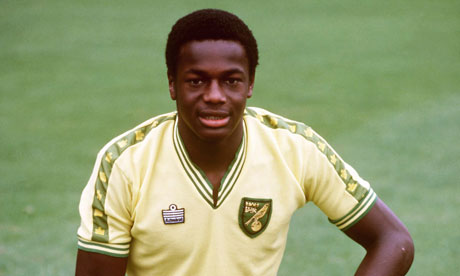
The only man brave enough to declare that he was gay and in the process take on all the obstacles that stood in his way and try and shoulder the expected amount of abuse was Justin Fashanu. Justin’s situation was a perfect storm for abuse, which made the openness with which he declared his sexuality perhaps more daring rather than courageous. Being black was described as being ‘hard enough’ at that time and after becoming the first ‘black one million pound player’ there was the added pressure to repay the club for such a large price tag. Not only would he be subject to disgusting chants from opposing fans but would also come under scrutiny from his own fans and manager as he failed to produce performances worthy of his price tag. Unfortunately after being accused of sexually assaulting a 17 year old boy in America he fled back to England where he committed suicide, suggesting in his suicide note that he had felt completely alone.

Although Justin’s situation was unique, the legacy that it has left in football is one that would frighten the ‘gay’ right out of a football player, or at least the idea of openly admitting to it. John Fashanu, the younger brother of Justin, joked that there would be more chance of the next pope being black than a footballer coming out as gay. I feel that this is an ancient view that is perhaps shared by the rather aged central processing unit at the FA. At the top of its hierarchy, British football has failed to feint past the issues of women in football and racism, what is there to suggest homophobia is another they cannot get past?


Despite attempting to market an anti-homophobia campaign, the FA was unable to get a single Premier League player or manager to support their campaign. Their advert, which was pulled, was criticised for being offensive rather than effective. Since then the governing body has failed to create a safe environment within which the minority of gay footballers feel safe to come out in. I can only imagine that withholding such a secret can be a lonely affair and thus the advice a player would seek could be crucial in determining whether they may feel able to speak out. It seems that many gay players would feel their careers would be over, affecting their reputation, their future earnings and their performances on the pitch. The Justin Foundation is one campaign that is attempting to challenge the stereotypes and misconceptions that exist around gay people and work towards a future where they are accepted and celebrated in football.


One thing that I do think has changed is the attitude towards homosexuality amongst the managers and players themselves. Being part of a dressing room myself I am all too familiar with the banter that flies around and I am certain that if someone were to ‘come out’ they would be far more likely to be at the epicentre of the humour rather than be discriminated against. It is the support of the players, the manager and the club that would make a player feel comfortable enough to express his feelings. Today a player is not targeted by his home fans for the colour of his skin, his nationality or his sexuality, but solely for his performance. Players have been targeted by the opposition support for all sorts of reasons, a tradition that will continue to occur; the point being, announcing you are gay will bring with it the same foul chants that have lived in football for decades.


I feel that in the near future, one player with be blessed with the perfect storm of conditions that will allow them to express their sexuality freely, from which others will have the courage to stand up and be heard. In fact it is perhaps far more likely that a retired player will come out before a current player. For now, nobody wants to take that leap, perhaps content with how their life is going. After all why would you want to jeopardise your career and reputation? Unfortunately football will never be just about what you can do on the pitch but I have faith that someone will feel comfortable enough to break down the stigmatic wall that surrounds homosexuality in football. 

Monday, 16 January 2012

Depression: Will the next generation live in fear?


The focus of today’s post evolved from the news that Dean Windass, memorable for his promotion to the premier league with Hull City and for his inconclusive match reports on Sky Sports News, attempted to commit suicide twice last week. Windass has admitted, in a very open confession of his mental condition, that he has cried ‘every day for two years’ since retiring and that he feels he has become a ‘failure’. This, along with the tragic death of Gary Speed, leads me to question whether the younger generation of sportsmen and women fear that their careers may ultimately be overshadowed by uncontrollable feelings of depression. Do they feel that when they retire they might not be able to seek the help needed to avoid the feelings of wanting to take one's own life?  


Research has revealed that after retiring or ending ones career suddenly, athletes can experience the same psychological stages as those who are grieving the loss of a loved one. Depression is one of the most difficult stages in the cycle as it varies in intensity and frequency, seemingly lingering like a stinking cold during the winter. The end of a career is a huge loss, as unlike you and I, who may decide to change occupation for the want of a new challenge, athletes are often forced to retire from a sport that they are still head over heels in love with. Ironically, almost as certain as death itself, somewhere during an athlete’s career, after soaring at the peak of their powers, there will be a come-down, a trough from which their playing career will never quite recover from. In terms of their lifetime, the length of this peak somewhat resembles that of the ‘high’ one experiences after tripping out on your everyday recreational drug, a feeling of ecstasy that anyone would miss. It is also proven that a reduction in exercise can increase depression levels as it is known to release ‘feel-good’ chemicals which are pro-active in reducing depression and anxiety.    


High profile cases of depression include that faced by Kelly Holmes who, left frustrated with injury, began to self-harm, whilst Frank Bruno and Paul Gascoigne were both sectioned under the Mental Health Act and received professional treatment for depression. Anxiety, the general term for several disorders that cause nervousness, fear, apprehension, and worrying, was the tragic burden that hampered and shortened the international career of arguably one of England’s most explosive and talented batsmen Marcus Trescothick. He described it as ‘the beast that lives inside’ and struggled particularly when touring abroad. Windass will seek help from Tony Adams’ Sporting Chance Clinic where he will receive support and counselling for the kinds of destructive behaviour patterns that exist in top level sport, only unable to attend today as the clinic is bursting at the seams with sportsmen and women seeking this help.

Susannah Strong, the author of a PFA booklet designed to educate and help retired footballers that may be suffering from depression, speaks of how unwilling players still active in our football leagues are to speak out. Instead she bemoaned how the booklet had to be based on articles written about retired players and their biographies. This seems to contradict the view of many that there is greater acceptance in sport, as clearly depression is still this taboo that sportsmen in particular are afraid to speak out about. Is the macho atmosphere of a dressing room too intimidating for the mind of someone struggling with depression? Imagine what it could be like for a young footballer who, after a string of bad performances or a long term injury, realises he is experiencing symptoms of depression. Would he be able to seek the help he needs. Contrary to the belief of many involved in the game, Susannah argues that, despite being groomed to ‘absolute physical perfection’, footballers are denied any attention to their mental health.

However has this now rapidly changed in the wake of influential figures speaking out? Freddie Flintoff, England’s talismanic cricketing all-rounder, recently produced a programme during which he not only expressed his own feelings of depression but opened up everyone’s eyes to the fragility of the mind possessed by a top level sportsman.  Have these examples acted as the catalyst that was needed to remove the shame and denial that has been loitering over the word ‘depression’. Today the sporting community seems to be in agreement that there is a better understanding of depression and, perhaps more importantly, a greater acceptance. This in addition to a more sympathetic and supportive stance from the media will only benefit athletes in the future. Perhaps instead of being frightened and worried about what may lie in store for the next generation of young talent, they now can take comfort in the fact that, if experienced, depression is nothing to be ashamed of and the support and framework for recovery is all around them. Good luck to Dean Windass, I look forward to him returning to Gillette Soccer Saturday, struggling to describe anything that has occurred in a game of football with any clarity!


Friday, 13 January 2012

What is it to be a fan?

At the end of a week where ‘The King’, Thierry Henry, returned to score the winner for his beloved Arsenal in a fashion no less predictable than the climax of any of the Mission: Impossible movies or an episode of CSI, I felt it important to discuss what it must be like to score a winner for the club that you support.


As all loyal supporters are aware, there is no feeling quite like celebrating a goal with upwards of 20,000 others, screaming, singing, jumping and even hugging. I stress the word ‘loyal’ as those of you who support Manchester United yet live in London and haven’t quite managed to make it to a game yet, don’t count (you know who you are). Even before I could walk, I have been a supporter of Portsmouth F.C., not that I would remember but I never really had a say in the matter. Nonetheless this blog has been inspired from my obsessive and, in recent years, frustrating love for all things Pompey. In fact the South Stand Upper Tier, the smashing title of this blog, was in fact where I held a season ticket for a number of years whilst we were battling for survival year in year out in the depths of the old Division One with the likes of Crystal Palace, Déjà vu?  

Having not visited too many games in a number of years I recently took my two younger brothers to see Portsmouth take on Watford in a bottom half of the table clash in the Npower Championship. Setting the scene it was an important tie between 17th and 18th, with Portsmouth only 3 points behind yet with a game in hand and a superior goal difference. A win for Portsmouth would leapfrog us above Watford and with Pompey’s home form being the third best in the entire league, having won 7, drawn 2 and lost just 2 of their home fixtures (clearly at this point questions are to be asked of our dire away form) many were optimistic. However it was not as straight forward as it seemed. Watford had turned us over 2-0 at their place just a month or so prior, a defeat that new boss Michael Appleton quoted as being our ‘worst performance of the season’. Now many of you reading this would not have had a clue or even cared about any of the pre-match hype that surrounded this game. You would easily be more concerned with your own team and similarly, up and down the country, not just on this particular Saturday in question, but on every Saturday (give or take, between the months of August and May) someone else would be telling an alarming yet perhaps just as melodramatic story of how their club would fare against the opposition. It is this enthusiasm of a fan, their affection for a team, which draws people together and gives us a reason to discuss and dispute the world of football.

Before the game on Monday night the majority of Arsenal fans would have thought they would have the game sewn up by half-time which would allow Henry a nice cameo on his return to the Emirates. Yet, like always, they needed to rely on the goal-scoring ability of one man, and for once this season it was not Robin Van Persie. Having scored 11 goals in his last 11 games against Leeds, it was to nobody’s surprise that with the most mechanical and recognisable of tekkers, Henry managed to slot the ball into the far corner, 1-0 to the Arsenal. I don’t think anybody in that ground, apart from a few Irish fans who still can’t get over ‘la main de dieu’ (the hand of god), didn’t applaud or enjoy the fairy tale return of one of the Premier League’s greatest players. It had that all too familiar feel to it, rekindling some of those final Highbury chapters in Arsenal’s history books. However what struck me was how surprised and confused Henry looked moments after slotting home that crisp finish. It was not the arrogant and nonchalant celebration that we had come so accustom to seeing from the Frenchman back in his heyday (a celebration whose reigns have now seemingly been taken up by Super Mario over at Eastlands). It was one with a complete contrast between bemusement and euphoria, one that perhaps you would only associate with someone who is overwhelmed with the outcome of scoring a goal like it was unfamiliar to them, someone who is unable to portray, through the medium of dance, gymnastics or theatrics, how much that moment meant to them, someone like a fan.  


Henry himself after the game admitted that he re-joined the club as a fan and was uncharacteristically flustered and speechless. It is no coincidence that scoring a goal as a fan has an effect on even the most seasoned of goal scorers. In similar fashion who can forget when that spotty, pale teenage sensation, Wayne Rooney blast onto the scene with that wonderful strike for his boyhood team, Everton against Arsenal (see video) or perhaps you could recall Neil Mellor scoring the winner for Liverpool against Arsenal (see video). It seems that the everyday ‘normal’ fan needs someone who they can relate to on the pitch, someone through which they can live out their dreams. Stephen Gerrard has done this every time he has worn a Liverpool shirt, as has John Terry for Chelsea and Dean Windass for Hull City. Joel Ward, a name that would not be too familiar to many of you, recently lived out his dream as a local lad and the dreams of many Portsmouth fans after scoring the equaliser against Southampton, our South Coast rivals. Today the association that fans have with their players is all important especially when your team are not doing so well. You could be sure as a Liverpool fan that regardless of the score, Stevie G would strive to ensure something is done about it. I just wonder that today with the influx of foreign owners, managers and players into our leagues will the fans lose this association and will this have a detrimental effect on the relationship between the club and its supporters. As a fan you look to players who aren’t simply playing for financial benefit, but are doing what they love for whom they love. Let us hope the fans don’t lose that one player that they can associate with.   


The game on Monday night was always going to be about Thierry Henry. The script had been written, the casting had been finalised, the ‘lights’, ‘camera…’ was all set to be followed by a cry of ‘action’, orchestrated by Arsene Wenger as he sent out his action hero. In reality though when you break down this Hollywood conclusion that had been played out on the big stage it was just a case of a fan realising his dream of scoring the winning goal for the club he idolises. With that goal Henry, like Rooney, Mellor, Ward and Gerrard, became a member of a niche group of players who each week realise the dreams of millions of fans all over the country. Long may this continue, starting with Joel Ward scoring against West Ham on Saturday, PLAY UP POMPEY!